Architectural shingles are thicker, layered asphalt shingles that outlast 3-tab. The install details on your estimate matter as much as the shingle itself.
That's the short version. The longer one matters because "architectural" is a word you'll probably see on any roofing quote you get, and on its own it tells you less than you'd think. Two estimates can both say architectural shingles and describe very different roofs.
You don't need to become a roofing expert to sort this out. You need to know what the ratings on the spec sheet mean and what a complete roof should include.
What makes a shingle "architectural"
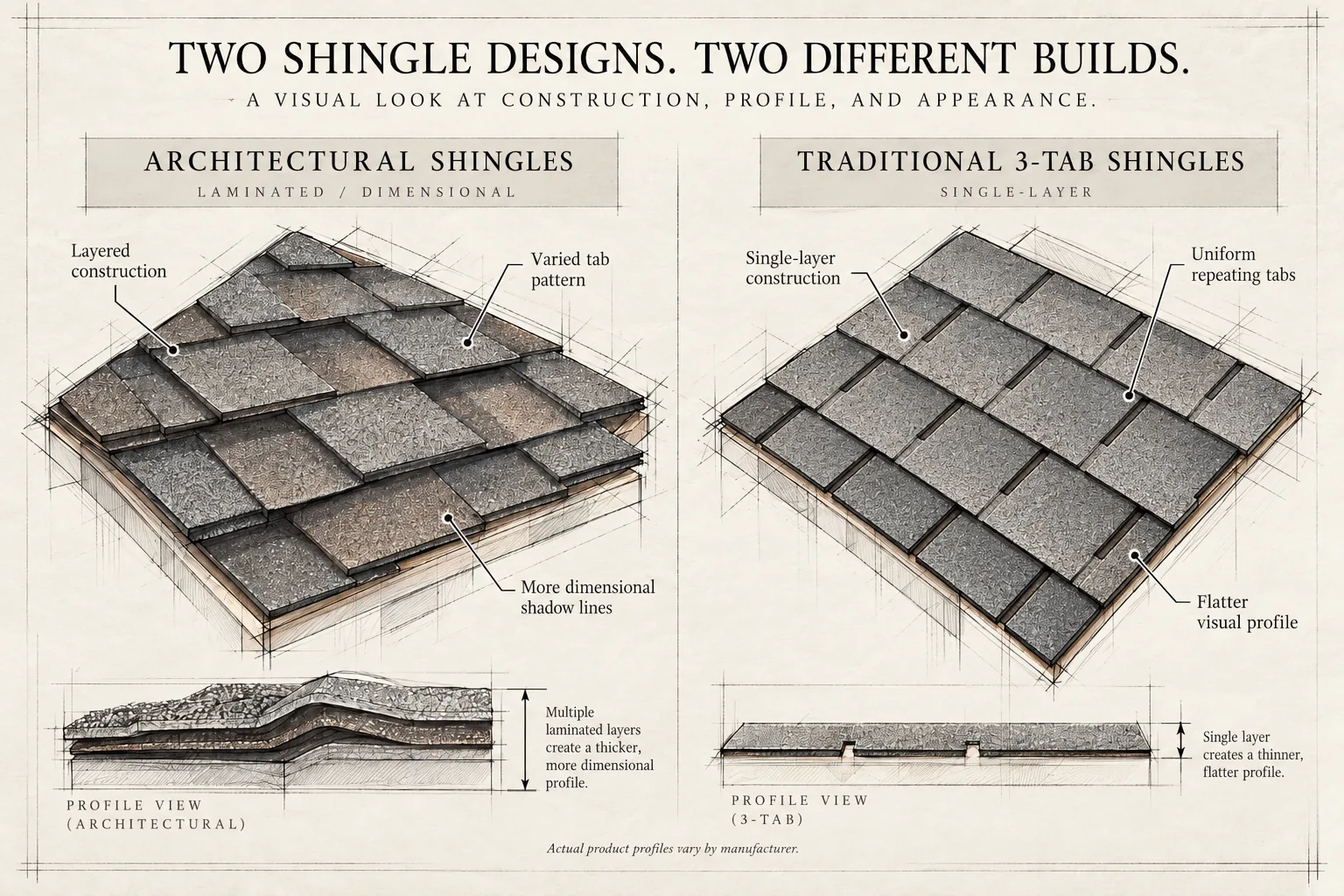
The Asphalt Roofing Manufacturers Association (ARMA) sorts steep-slope asphalt shingles into a few types. Strip shingles are the flat ones, about three times as long as they are wide, and the most common strip shingle is the 3-tab. Laminated shingles have more than one layer of tabs to build extra thickness. ARMA says those are also called three-dimensional or architectural shingles.
So architectural and laminated mean the same basic product. CertainTeed describes its Landmark line as a "dual-layered design," and IKO calls its Dynasty shingle a laminated shingle.
ARMA says that thickness gives the roof visual depth, which is the shadowed, uneven look most people picture.
How long do architectural shingles last?
The International Association of Certified Home Inspectors puts architectural asphalt shingles at 30 years and 3-tab at 20 in its life expectancy chart. Those are estimates, and weather moves the number. In Florida that means hurricanes, tropical storms and strong sun all year. InterNACHI notes that roofs in areas with severe weather, hurricanes included, can have a shorter-than-normal lifespan or pick up damage that needs repair. In Georgia it's hail and long summer heat. For the Florida side in more detail, see how long a roof lasts in Florida.
A label on the bundle that says "lifetime" isn't a lifespan either. More on that in the warranty section.
Are architectural shingles worth it over 3-tab?
For most homeowners replacing a roof, yes. The longer expected life alone makes the case. The better question is which architectural shingle, installed how.
Here's where people get tripped up. Architectural doesn't automatically mean wind-rated to the top class, and it doesn't mean hail resistant. Those are separate test ratings, and they're printed on the product's spec sheet, not in the name.
Wind ratings, decoded
You'll see two wind test standards on asphalt shingle spec sheets. ARMA's product and test standards page explains both.
ASTM D3161 (fan-induced method). A deck of shingles is prepared and conditioned, then fan-driven "wind" is blown across it. The highest wind speed reached without any part of a shingle lifting sets the class. Class F is the top rating. ARMA points out a mismatch worth knowing: building codes base wind design on three-second gusts, but this test runs for two hours.
ASTM D7158 (uplift resistance method). This one looks at the strength of the sealant bond plus the shingle's own stiffness. ARMA says the lab results can be compared directly to the three-second gust design wind speeds in the code. Class H is the top rating here.
The re-roof guide published for the City of East Point, a metro Atlanta city working from the 2018 International Residential Code, says asphalt shingles have to be tested to ASTM D7158 and meet the code's classification table. Check what your own city or county requires.
Some architectural shingles carry both top classes. IKO's Dynasty spec sheet lists D3161 Class F and D7158 Class H. Whatever the brand, ask to see the ratings on paper for the exact product in your estimate.
Wind warranties come with conditions
Some manufacturers attach a separate wind warranty, and the fine print matters. CertainTeed's Landmark page lists a 110 mph wind-resistance warranty with an upgrade to 160 mph available, and says the upgrade requires CertainTeed starter and CertainTeed hip and ridge. In other words, the accessories on your estimate can decide which wind coverage you actually get.
Impact ratings and hail
Hail is a real concern in north Georgia. The National Weather Service office in Peachtree City found in its severe weather climatology that nearly all hailstorms in its area hit between February and August, and April leads.
The rating you'll see for hail is UL 2218. ARMA describes it as a lab test that drops steel balls of different sizes from 12 to 20 feet onto a deck of shingles, with four classes and Class 4 as the best. ARMA also notes impact resistance isn't required by the building codes. So it's an option you choose.
Malarkey Roofing Products lays out the Class 4 test in plain terms: a 2-inch steel ball dropped from 20 feet, twice in roughly the same spot, and the shingle passes if the back shows no tearing, cracking, splitting or other opening. Malarkey also quotes UL saying the test doesn't evaluate weathering, temperature, aging or similar effects.
Two things to hear straight:
- Architectural isn't the same as Class 4. CertainTeed Landmark and IKO Dynasty, both architectural, are listed as UL 2218 Class 3 on their own product pages.
- An impact rating isn't hail coverage. IKO's impact rating disclaimer on the Dynasty page says the rating isn't a guarantee of impact resistance against hail, and that hail damage isn't covered under its limited warranty.
If anyone tells you a Class 4 shingle means hail can't touch your roof, that's a bigger promise than the manufacturers make.
Algae-resistant shingles
Dark streaks on a shingle roof are usually algae. ARMA's algae discoloration page says algae-resistant shingles are built to inhibit growth for extended periods, and suggests considering them when you reroof. It also warns against power washing or brushing a shingle roof.
On the two product pages we checked, algae coverage runs on its own clock. CertainTeed lists a 25-year StreakFighter algae-resistance warranty on Landmark, and IKO lists a 10-year algae resistance warranty on Dynasty. Different numbers, different terms. Read them.
What the manufacturer warranty actually covers
"Lifetime" has a defined meaning. On the Dynasty page, IKO defines it as the period from the end of installation for as long as the owner owns the building. That's ownership language, and it says nothing about how long the shingles will last.
Both of those product lines also come with an early-coverage period. IKO's warranty page describes its Iron Clad Protection Period as 15 years of coverage for manufacturer defects on its Performance products. CertainTeed lists 10-year SureStart protection on Landmark.
Then there are extended tiers that only certain installers can offer. IKO says Select and Craftsman Premier members of its ROOFPRO program can offer extended Iron Clad Protection, and that the ROOFPRO contractor registers the extended warranty for you. The Dynasty page adds that those extended warranties may have different application requirements.
And if you sell the house? IKO says transfer terms vary by year and product, so check the limited warranty that was in effect when your shingles went on.
Questions worth asking any roofer, in writing:
- Which manufacturer warranty comes with this roof, standard or an extended tier?
- If it's extended, who registers it, and when do I get the paperwork?
- Does it require that manufacturer's starter and ridge cap?
- What would void it?
- What covers the workmanship, separate from the shingles, and for how long?
The NRCA contractor checklist, published on the FORTIFIED Home site, puts it simply: read and understand any roofing warranty offered, and watch for provisions that would void it.
What a complete roof should include
A roof is a system of parts. ARMA's roofing system components page lists six parts that work together: shingles, underlayment, ice and water barriers, starter strip, hip and ridge, and balanced attic ventilation. A complete roof includes all six, plus a plan for the wood underneath.
Here's what a complete roof job covers. Whoever you hire, ask how each one is handled.
Tear-off or overlay. Is the old roof coming off down to the deck? East Point's re-roof guide says no more than two layers are allowed, and a new roof can't go over one that's water-soaked or already has two or more layers. Even where an overlay is legal, you can't see the deck you're covering.
Decking replacement policy. On a tear-off, nobody knows the deck's condition until the shingles are off. The East Point guide says boards or sheathing that are "warped, cracked or delaminated between supports" have to be repaired or replaced. Ask how replacement decking is counted and billed, and whether you'll see photos first.
Underlayment. ARMA calls it a secondary water barrier between the deck and the shingles. Ask what product, and whether it's synthetic or felt.
Ice and water barrier. ARMA puts it in valleys and around chimneys, the spots where water runs. Ask where it goes on your roof.
Starter strip. ARMA says starter products give the first row of sealant that helps prevent blow-offs. East Point's guide requires a starter course at the eave.
Drip edge. The East Point guide requires drip edge around the entire perimeter. If one estimate lists it and the other doesn't, ask why.
Hip and ridge. Matching ridge cap is part of some wind warranties, as the CertainTeed example above shows.
Ventilation. ARMA's position is that steep-slope attics should be vented, with balanced intake and exhaust. The East Point guide restates the code's ventilation area rules and says insulation can't block eave vents. ARMA ties balanced ventilation to keeping the attic closer to outside temperature, which it says helps prevent premature shingle deterioration.
Flashing, vents and pipe boots. East Point says roof jacks and vents in poor condition, or badly rusted, must be replaced, along with damaged or rusted metal.
Permit and inspection. The East Point guide says a re-roof needs a permit and a final roof inspection, and advises having the contractor apply for the permit.
Cleanup. Ask how nails and debris get picked up, and whether that's in the price or extra.
FAQ
Are architectural shingles worth it?
For most roof replacements, yes. They're thicker than 3-tab and InterNACHI gives them a longer expected life. Then compare the specific product's ratings and the parts installed with it.
How long do architectural shingles last in Georgia and Florida?
InterNACHI estimates about 30 years for architectural asphalt shingles. Hurricanes and year-round sun in Florida, and hail and long summers in Georgia, can shorten that.
Do architectural shingles handle wind and hail better?
Some carry the top wind classes, ASTM D3161 Class F and ASTM D7158 Class H, so check the spec sheet. Hail resistance is a separate UL 2218 rating, and both architectural lines we checked are Class 3, not Class 4.
Are impact resistant shingles the same as architectural shingles?
Not always. Impact resistant means the product carries a UL 2218 class, and CertainTeed markets Landmark, a Class 3 architectural shingle, as impact resistant. Class 4 is the top of the scale.
Book a roof inspection in metro Atlanta
Superior Roofing & Restoration is a veteran-operated company with an office in Peachtree Corners, and Victoria covers Atlanta for our team. An inspection visit takes about 90 minutes. We walk the roof, take photos of what we find, show you a sample board, take measurements, and hand you a firm written number. If the roof just needs a repair, we'll say so.
Want to see what a complete roof would look like on your house? Book a roof inspection, read about our roof replacement work, or contact us. You can also call 844-TARP-247.
Sources
- ARMA, Types of Asphalt Roofing: strip and 3-tab shingles; laminated shingles also called architectural
- ARMA, Asphalt Shingle Product and Test Standards: ASTM D3161 Class F, ASTM D7158 Class H, three-second gust vs two-hour test, UL 2218 drop test and classes, impact resistance not required by code
- ARMA, Asphalt Roofing Systems Components: the six roof system components and ARMA's ventilation position
- ARMA, Algae Discoloration: algae-resistant shingles and cleaning cautions
- InterNACHI, Standard Estimated Life Expectancy Chart for Homes: architectural 30 years, 3-tab 20 years; severe weather, hurricanes included, can shorten roof life
- City of East Point GA (SAFEbuilt), 2018 IRC Residential Re-Roof guide: permit and final inspection, two-layer limit, recover limits, sheathing repair, starter course, drip edge, ventilation rules, ASTM D7158
- Malarkey Roofing Products, Class 4 impact resistance shingles: Class 4 steel-ball test and UL's note on weathering and aging
- IKO, Dynasty performance shingles: laminated; D3161 Class F, D7158 Class H, UL 2218 Class 3; impact rating disclaimer; "lifetime" definition; algae warranty; ROOFPRO extended warranty note
- IKO, Warranty information for homeowners: Iron Clad Protection, ROOFPRO extended coverage and registration, transfer terms
- CertainTeed, Landmark shingles: dual-layered design, UL 2218 Class 3, SureStart, StreakFighter algae warranty, wind warranty upgrade requirements
- National Weather Service Peachtree City, severe weather climatology: hail season in north and central Georgia
- FORTIFIED Home (IBHS) with NRCA, How to Select a Roofing Contractor: written proposal, warranty reading, price as one criterion